
Volume III · The Houses
Qing dynasty
Manchu dynasty founded by the Aisin Gioro clan; proclaimed in 1636 and ruling China after the conquest of Beijing in 1644.
This entry has no dated engagement span in the atlas yet.
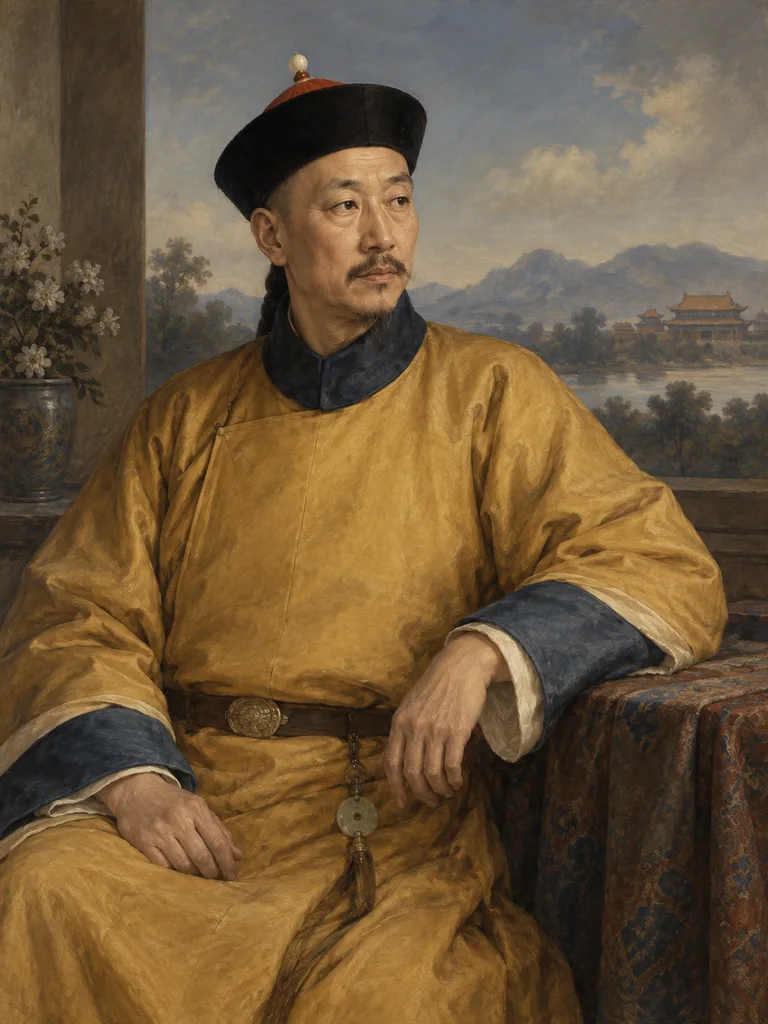
Created for Dylanvir LLC using Codex image generation from our original prompts.
AI-generated interpretation: face, clothing, and setting are imagined.
Follow one chapter at a time, or open the whole account.
01How it began
Manchu dynasty founded by the Aisin Gioro clan; proclaimed in 1636 and ruling China after the conquest of Beijing in 1644.
02At its height
High Qing era under the Kangxi, Yongzheng, and Qianlong emperors (roughly 1683-1799); largest territorial extent and population in Chinese history.
Territory in the record
China proper, Manchuria, Mongolia, Tibet, Xinjiang, and Taiwan.
03What became of it
Weakened by the Opium Wars, the Taiping Rebellion, and foreign encroachment; overthrown in the Xinhai Revolution, with the last emperor abdicating in 1912.
04What remained
Defined the modern territorial extent of China; the Eight Banners military system and a multiethnic empire under Manchu rule.
Flags, arms & symbols
A closer look at the designs associated with this entry. Open an illustration to read its story.
 FlagThe yellow dragon flagLate Qing; this flag type from around 1889Read the symbolClose the story
A blue, curling dragon faces a red flaming pearl against yellow. The drawing simplifies the embroidered creature into an illustrated study.
Penn Museum dates its example to 1889-1904 and describes this flag type as adopted around 1889. It is much later than Kangxi. This is a schematic interpretation, not a facsimile of the museum textile.
Original illustrations for Dylanvir LLC, drawn with Codex after the linked historical references. These are schematic drawings, with simplified shapes and colours, not photographs of surviving objects. Each caption identifies the use shown.
Made for Dylanvir LLC · about these images
The painted portraits and landscapes were created here with Codex image generation from our original prompts, written for this collection. They are original generated illustrations, not photographs or reproductions of archival portraits.
Each house portrait accompanies a person already named in its account. Faces, clothing, and settings are imagined; a realistic painting does not establish a historical likeness. Entries without a named figure keep their text without an invented representative.
The flags and heraldic drawings are original illustrations for Dylanvir LLC, drawn with Codex after their linked historical references. The designs themselves belong to their historical or living traditions. Captions distinguish flags, coats of arms, parts of arms, and badges, and identify the period and use shown.
This reading keeps the wording of the atlas's public house entry. The people named here are those in this entry, not a complete family tree. About the sources ↗