
What keeps a town alive?
Begin with a place and the work that brought it into being. Then ask what could keep people there.
More ways into the collections
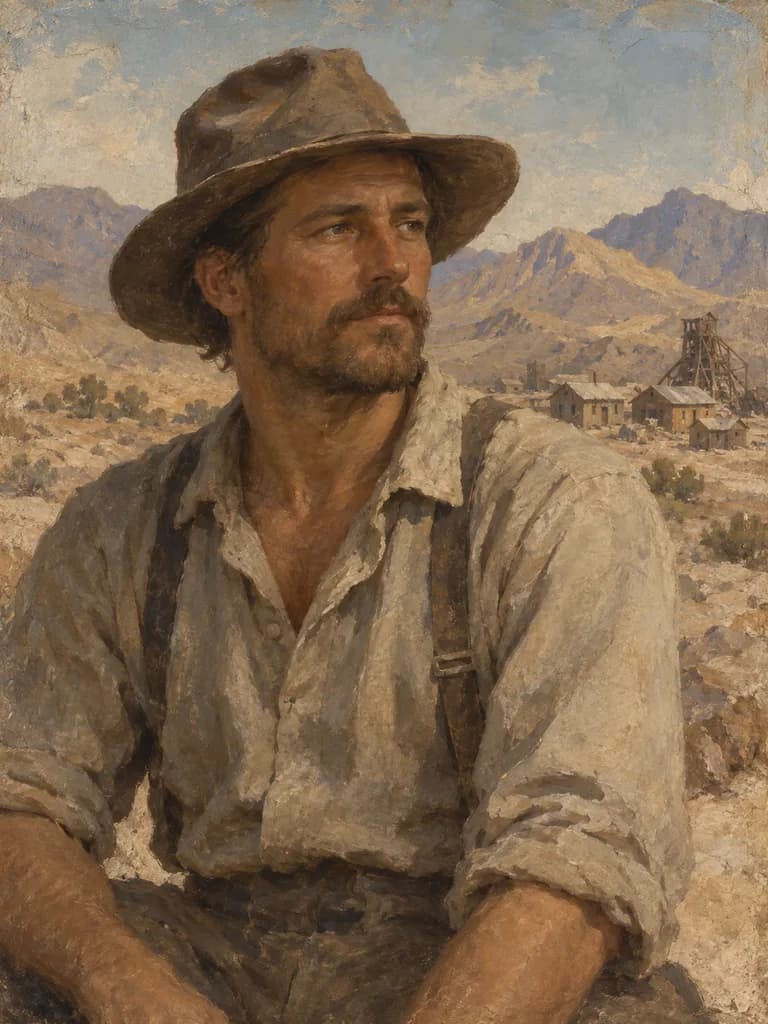
The promise of a boomtown
Banks, a stock exchange, electric light. Rhyolite had the outward signs of a place built to last. Underneath them was an orebody.
What happens to the town when the thing that drew people here can no longer sustain it?
Reveal Rhyolite’s outcome
A ghost town
The register records Rhyolite as a ghost town. Its buildings could outlast the activity that had brought them into being.
In this register: founded 1904; ended 1916. These are the register’s dates and classification.
Read the register’s account
Banks, a stock exchange, electric light, and a school finished in 1909 that almost no child ever attended. Twelve years from first stake to empty.
The question travels beyond either town: does a place depend on something that gets spent, or on activity that can keep returning?
Open the idea: stock and flow
Stock
A finite supply. Using it reduces what remains. Ore is the example in this account.
Flow
A continuing source of activity. Using it does not itself exhaust it. Water and transport routes are the account’s examples.
A route can move. Water can be reallocated. A town can gain new reasons to exist. These examples introduce an explanation; they do not establish a universal law. The comparisons below also depend on how the register distinguishes a living town from a remnant.
The pattern in the registerRead the earlier account, its comparisons, and the limits of the explanation.
the town register
The state with more dead towns than living ones
Nevada is usually credited with 600-plus ghost towns against roughly 175 zip-coded places. This register carries 28, and every number below is computed from it rather than asserted — so it can be checked, and it can be wrong.
stock or flow
A settlement’s expected life is a function of whether its founding resource is a stock or a flow. Ore is a stock: finite, and consumed by the act of using it. Water, a rail junction, a county seat and a road are flows — they renew, and using them does not spend them.
- 50% vs 90%
- Survival of stock-founded against flow-founded places (4/8 against 9/10).
- 20% vs 92%
- The same test on the larger register — same direction, much softer magnitude.
- 40 years
- Median lifespan of the dead towns, founding to abandonment.
- Rhyolite, 12y
- Banks, a stock exchange and electric light, then nothing.
The direction is robust and replicated across two independently built tables. The magnitude is not. The two sets draw the line between “remnant” and “living” in different places, and Dayton and Virginia City move the result on their own. Anyone quoting 20% and 92% as though they were measurements has taken a status boundary for a fact.
⚠ The weakest assignment in the table is trail, classed as a flow: a trail renews like a river, but unlike a river it can be re-routed, and Genoa is a single case propping up that call. The reason this is a law rather than a description of Nevada is that it travels — it should mean the same in Cornwall, the Ruhr and the Chilean nitrate desert, and those are the places it could fail.
why a place is HERE
Zero out of eleven
Ask of every town not what industry founded it, but why it is here and not five miles away. In country this hostile the reasons are physical and countable — and the result is the cleanest in the volume.
- 0 of 11
- Towns with a single reason to exist that are still living. Not one of them survived.
- 15 of 17
- Towns with two or more. A site with one reason dies when that reason fails.
- resource 3/15
- water 10/11
- junction 10/11
- admin 3/4
- adjacency 3/3
- crossing 2/2
- boundary 2/2
- power 2/2
Only one reason fails. Resource sustains a fifth of the towns it founded; water and junction each sustain nine in ten. And this beats stock-or-flow on its own terms, because it is a description of the ground rather than a judgement about an economy — you can stand at a site and count the reasons before looking anything up.
⚠ The assignment of reasons is mine and is the attackable part. The small categories — crossing, boundary, power, adjacency — each rest on two or three towns and prove nothing alone. The load is carried by resource against water and junction, where the n is large enough to mean something.
Follow the waterOpen the map and see how towns sit along the corridors.
one line, drawn four times
Ogden came onto the Humboldt in 1828 because it was the only water running west. The trappers followed the water, the emigrants followed the trappers, the Central Pacific followed the emigrants, and Interstate 80 follows the railroad. Every northern town is a bead on that string, and the whole of it was decided by hydrology before anyone arrived to have an opinion.
⚠ Stylized, not surveyed. The outline is a seven-point polygon and the trails are indicative corridors, not surveyed routes — they are drawn to show that the water, the trail, the railroad and the interstate are one line, which is the argument. Nothing on this plate should be measured.
Why does the route stop here?Explore canyons, crossings, crew changes and the places between them.
the chokepoints
What forces a stop, and at whose range
Spacing encodes the technology that laid the route out. Ox wagons made 12–15 miles a day. Pony Express remounts were 10–15 apart. Steam took water every 20–25 miles and changed crews every 100–150. Early motoring wanted fuel every 30–50. So measure the gaps between towns on a corridor and the number tells you which machine drew it.
| Node | Kind | Cadence | The constraint | Stacked on it |
|---|---|---|---|---|
| Carlin Canyon | constriction | none | The Humboldt cuts through the range rather than around it. One line exists.The gorge was often impassable to wagons, which is why trains of the 1840s-50s climbed over Emigrant Pass instead. Rail and highway went through once the technology allowed. Four eras, one line: this is the type specimen for a constriction. | California Trail · Central Pacific · US 40 · I-80 |
| Big Meadows (Lovelock) | river | ox-wagon | Last dependable grass and water before forty waterless miles.Emigrants cut and carried hay here. A node defined entirely by the gap after it. | California Trail · Central Pacific · I-80 |
| Humboldt Sink | terminus | none | The river ends. No outlet, no onward water. | California Trail |
| Big Bend of the Truckee (Wadsworth) | river | ox-wagon | First water after the Forty Mile Desert on the northern fork.Southern Pacific moved its shops from here to Sparks in 1904, which is why Wadsworth is small and Sparks is not. | California Trail · Central Pacific |
| Genoa | spring | ox-wagon | Range-front water at the base of the Sierra, at the foot of the passes.First permanent non-Native settlement, 1851. Range-front springs run in a line along a fault; Genoa sits on that line where it meets the crossing. | Carson Route · Kingsbury Grade |
| Donner Pass | constriction | none | 7,056 ft. Not the lowest Sierra crossing, but the one with water on both approaches.Beckwourth at 5,221 ft is far lower and carried a fraction of the traffic. Elevation alone never predicts a pass; approaches do. | Truckee Route · Central Pacific · US 40 · I-80 |
| Sparks | interval | steam-crew | Nothing terrain-related. A division point placed where the railroad wanted its shops.Created 1904 out of open ground. The clearest case in the state of spacing beating geography — the town exists because a locomotive needs a crew change, not because anything is there. | Central Pacific / Southern Pacific · I-80 |
| Elko | interval | steam-crew | Division-point spacing on the Humboldt, with river water on hand.River plus interval is the combination that produces a durable town rather than a siding. | California Trail · Central Pacific · I-80 |
| Winnemucca | junction | steam-water | Humboldt corridor meets the route north toward Oregon.Junction plus water. This is why the Thacker Pass workforce hub is here and not at the mine. | California Trail · Applegate turnoff approach · Central Pacific · I-80 · US 95 |
| Hawthorne | spring | motor | Walker Lake is the only water on a very long stretch of the north-south corridor.The ammunition depot is here because the corridor is empty and the water is not. | Carson & Colorado · US 95 |
| Schurz | junction | steam-water | Walker River crossing where US 95 and 95A meet.The 1881 railroad crossing agreed between Schurz and Yerington put the town here. Both names on the corridor come from that one negotiation. | Carson & Colorado · US 95 · US 95A |
| Austin | interval | motor | Roughly a hundred miles of nothing in either direction on the central route.Significance is a function of the emptiness downstream, not of anything present. Persists long after its ore did. | Pony Express / Simpson route · Lincoln Highway · US 50 |
| Tonopah | spring | motor | A spring in open desert, midway on the north-south corridor.Butler stopped at the water and found the ore. Order of operations matters: the water is why anyone was there to look. | US 6 · US 95 |
| Fernley | junction | motor | Where the Truckee Canal leaves the river corridor, and where I-80 meets US 50 Alt.Founded c.1904 on the canal. Now a logistics node for the same reason: it is where two corridors cross. | Truckee Canal · I-80 · US 50 Alt · Victory Logistics District |
how to read a new area
- 1. Trace the base of each range. Groundwater surfaces at the range front, so springs run in a line along the fault. Every candidate site is on that line or on a river.
- 2. Find the constriction — canyon, pass, ford, narrows. Where a modern highway, a railroad and a wagon route lie on top of one another, the terrain permitted exactly one line.
- 3. Measure the spacing. The interval names the technology.
- 4. Ask what has to be stored there. A chokepoint plus one unit of range is where somebody must stockpile fuel, water, feed or people.
A stage station, a tank town, a truck stop and a workforce hub are the same object at four cadences: a forced stop, sized to the range of whatever is doing the moving.
Open the town registerExplore individual towns, their dates, and the reasons assigned to their sites.
open a town
Why is it here, and did that hold
Every town opens onto a locator, the reasons it exists, and how long it lasted. The reasons are the argument: an orebody is the only one on the list that can be exhausted — water gets reallocated, a crossing moves only if the route moves, a county seat lasts as long as the county. A town standing on one reason has one thing that can be taken away from it.
▸Dayton1850living
Lyon county
what put it here
- an orebodyCAN BE EXHAUSTED — the only one on this list that can
- watercan be reallocated by decree, but not used up
- a junctionoutlives the traffic that made it
how long it lasted
176 years and counting, peak about 2,500 people.
Gold Canyon. Nevada's first gold, panned by emigrants who were only waiting for the Sierra snow to clear.
▸Genoa1851living
Douglas county
what put it here
- watercan be reallocated by decree, but not used up
- a crossingmoves only if the route moves
- a junctionoutlives the traffic that made it
how long it lasted
175 years and counting, peak about 800 people.
Mormon Station — the first permanent non-Native settlement in Nevada. Emptied by the 1857 recall, then resettled by people who were not going anywhere.
▸Carson City1858living
Carson City county
what put it here
- watercan be reallocated by decree, but not used up
- a seat of governmentlasts as long as the county does
- a junctionoutlives the traffic that made it
how long it lasted
168 years and counting, peak about 58,000 people.
Laid out with a plaza reserved for a capitol six years before there was a state to need one.
▸Virginia City1859remnantone reason
Storey county
what put it here
- an orebodyCAN BE EXHAUSTED — the only one on this list that can
how long it lasted
167 years, peak about 20,000 people.
The Comstock. Burned in 1875 and rebuilt inside a year because the Big Bonanza was running. Under a thousand people now.
One reason. Whatever put this place here is the only thing holding it, and if it was an orebody then the town is a bet on a finite quantity that nobody measured first.
▸Aurora1860–1919ghostone reason
Mineral county
what put it here
- an orebodyCAN BE EXHAUSTED — the only one on this list that can
how long it lasted
59 years, peak about 6,000 people.
Nobody knew which state it was in — it served as a county seat for both Nevada and California at once until the survey settled it. Mark Twain mined here and failed.
One reason. Whatever put this place here is the only thing holding it, and if it was an orebody then the town is a bet on a finite quantity that nobody measured first.
▸Unionville1861remnantone reason
Pershing county
what put it here
- an orebodyCAN BE EXHAUSTED — the only one on this list that can
how long it lasted
165 years, peak about 1,500 people.
Twain lasted a fortnight. About twenty people remain.
One reason. Whatever put this place here is the only thing holding it, and if it was an orebody then the town is a bet on a finite quantity that nobody measured first.
▸Austin1862remnant
Lander county
what put it here
- an orebodyCAN BE EXHAUSTED — the only one on this list that can
- a junctionoutlives the traffic that made it
how long it lasted
164 years, peak about 10,000 people.
Silver reportedly found by a Pony Express horse kicking over a rock. Roughly 200 people left.
▸Pioche1864remnantone reason
Lincoln county
what put it here
- an orebodyCAN BE EXHAUSTED — the only one on this list that can
how long it lasted
162 years, peak about 6,000 people.
Said to have buried seventy-five men before anybody died of natural causes. The claim is unverifiable and repeated everywhere.
One reason. Whatever put this place here is the only thing holding it, and if it was an orebody then the town is a bet on a finite quantity that nobody measured first.
▸Belmont1865–1911ghost
Nye county
what put it here
- an orebodyCAN BE EXHAUSTED — the only one on this list that can
- a seat of governmentlasts as long as the county does
how long it lasted
46 years, peak about 2,000 people.
County seat until 1905, when the county government followed the money to Tonopah and left the courthouse standing empty.
▸Hamilton1868–1931ghostone reason
White Pine county
what put it here
- an orebodyCAN BE EXHAUSTED — the only one on this list that can
how long it lasted
63 years, peak about 12,000 people.
The White Pine rush — rich, enormous, and finished inside a decade. A shopkeeper burned the business district down in 1873 for the insurance.
One reason. Whatever put this place here is the only thing holding it, and if it was an orebody then the town is a bet on a finite quantity that nobody measured first.
▸Reno1868living
Washoe county
what put it here
- a crossingmoves only if the route moves
- watercan be reallocated by decree, but not used up
- a junctionoutlives the traffic that made it
how long it lasted
158 years and counting, peak about 275,000 people.
Lake's Crossing, platted by the Central Pacific and named for a Union general who never set foot in Nevada.
▸Elko1868living
Elko county
what put it here
- watercan be reallocated by decree, but not used up
- a junctionoutlives the traffic that made it
how long it lasted
158 years and counting, peak about 20,000 people.
Railroad townsite on the Humboldt; held the university until 1885. Basque country.
▸Winnemucca1868living
Humboldt county
what put it here
- watercan be reallocated by decree, but not used up
- a junctionoutlives the traffic that made it
how long it lasted
158 years and counting, peak about 8,000 people.
Named for the Northern Paiute chief, on the river his people lived along.
▸Eureka1869remnantone reason
Eureka county
what put it here
- an orebodyCAN BE EXHAUSTED — the only one on this list that can
how long it lasted
157 years, peak about 9,000 people.
Lead-silver smelting on a scale that stripped whole ranges for charcoal. About 600 people.
One reason. Whatever put this place here is the only thing holding it, and if it was an orebody then the town is a bet on a finite quantity that nobody measured first.
▸Delamar1894–1934ghostone reason
Lincoln county
what put it here
- an orebodyCAN BE EXHAUSTED — the only one on this list that can
how long it lasted
40 years, peak about 3,000 people.
The ore was milled dry and the silica dust went through the whole camp. It was called the Widowmaker and it earned the name.
One reason. Whatever put this place here is the only thing holding it, and if it was an orebody then the town is a bet on a finite quantity that nobody measured first.
▸Fallon1896living
Churchill county
what put it here
- watercan be reallocated by decree, but not used up
- a seat of governmentlasts as long as the county does
how long it lasted
130 years and counting, peak about 9,000 people.
The Lahontan Valley: alfalfa, dairy and cantaloupes, grown on water taken out of the Truckee before it can reach Pyramid Lake.
▸Tonopah1900living
Nye county
what put it here
- an orebodyCAN BE EXHAUSTED — the only one on this list that can
- a junctionoutlives the traffic that made it
how long it lasted
126 years and counting, peak about 10,000 people.
The strike that stopped thirty years of decline and ended the talk of repealing Nevada's statehood.
▸Goldfield1902remnantone reason
Esmeralda county
what put it here
- an orebodyCAN BE EXHAUSTED — the only one on this list that can
how long it lasted
124 years, peak about 20,000 people.
The largest city in Nevada in 1907 and the last true boomtown in the American West. A few hundred people now.
One reason. Whatever put this place here is the only thing holding it, and if it was an orebody then the town is a bet on a finite quantity that nobody measured first.
▸Sparks1904living
Washoe county
what put it here
- a junctionoutlives the traffic that made it
- next to something biggerdepends on somebody else staying
how long it lasted
122 years and counting, peak about 110,000 people.
Built as railroad shops; named for the cattleman governor who sent troops into Goldfield.
▸Rhyolite1904–1916ghostone reason
Nye county
what put it here
- an orebodyCAN BE EXHAUSTED — the only one on this list that can
how long it lasted
12 years, peak about 5,000 people.
Banks, a stock exchange, electric light, and a school finished in 1909 that almost no child ever attended. Twelve years from first stake to empty.
One reason. Whatever put this place here is the only thing holding it, and if it was an orebody then the town is a bet on a finite quantity that nobody measured first.
▸Bullfrog1904–1916ghostone reason
Nye county
what put it here
- an orebodyCAN BE EXHAUSTED — the only one on this list that can
how long it lasted
12 years, peak about 1,000 people.
Rhyolite's twin, half a mile away, and it lost. The empty county invented in 1987 to fight Yucca Mountain borrowed its name.
One reason. Whatever put this place here is the only thing holding it, and if it was an orebody then the town is a bet on a finite quantity that nobody measured first.
▸Fernley1904living
Lyon county
what put it here
- watercan be reallocated by decree, but not used up
- a junctionoutlives the traffic that made it
how long it lasted
122 years and counting, peak about 22,000 people.
A Newlands Project town on the canal benches — one of the very few Nevada towns founded on water rather than ore, and one of the few still growing.
▸Las Vegas1905living
Clark county
what put it here
- watercan be reallocated by decree, but not used up
- a junctionoutlives the traffic that made it
- a state linelasts as long as the line does
how long it lasted
121 years and counting, peak about 660,000 people.
A railroad water stop, auctioned off in lots over two days — at the same springs the caravans watered at in 1830.
▸Ely1906living
White Pine county
what put it here
- an orebodyCAN BE EXHAUSTED — the only one on this list that can
- a seat of governmentlasts as long as the county does
how long it lasted
120 years and counting, peak about 6,000 people.
Copper, in volume, by corporation — the boom that produced a payroll instead of prospectors, and lasted longest for exactly that reason.
▸Metropolis1911–1949ghostone reason
Elko county
what put it here
- watercan be reallocated by decree, but not used up
how long it lasted
38 years, peak about 700 people.
An agricultural colony sold to Eastern farmers with a hotel and a school. Its water rights turned out to be junior to Lovelock's, a court took the water, and jackrabbits and Mormon crickets took what was left. The one Nevada ghost town killed by a lawsuit.
One reason. Whatever put this place here is the only thing holding it, and if it was an orebody then the town is a bet on a finite quantity that nobody measured first.
▸Boulder City1931living
Clark county
what put it here
- powerfollows the grid
- next to something biggerdepends on somebody else staying
how long it lasted
95 years and counting, peak about 16,000 people.
Built by the government to house dam workers, with gambling banned inside the city limits. Still banned.
▸Henderson1941living
Clark county
what put it here
- powerfollows the grid
- next to something biggerdepends on somebody else staying
how long it lasted
85 years and counting, peak about 330,000 people.
A magnesium plant with a town attached, running on dam power. Now the second city in the state.
▸Laughlin1964living
Clark county
what put it here
- a state linelasts as long as the line does
- watercan be reallocated by decree, but not used up
how long it lasted
62 years and counting, peak about 7,500 people.
One man, one boarded-up motel, one bridge — on ground that belonged to Arizona until 1866.
the register
| Town | County | Founded | Ended | Life | Peak | What built it, what killed it |
|---|---|---|---|---|---|---|
| Dayton | Lyon | 1850 | — | 176y | ~2,500 | Gold Canyon. Nevada's first gold, panned by emigrants who were only waiting for the Sierra snow to clear. |
| Genoa | Douglas | 1851 | — | 175y | ~800 | Mormon Station — the first permanent non-Native settlement in Nevada. Emptied by the 1857 recall, then resettled by people who were not going anywhere. |
| Carson City | Carson City | 1858 | — | 168y | ~58,000 | Laid out with a plaza reserved for a capitol six years before there was a state to need one. |
| Virginia City | Storey | 1859 | — | 167y | ~20,000 | The Comstock. Burned in 1875 and rebuilt inside a year because the Big Bonanza was running. Under a thousand people now. |
| Auroraghost | Mineral | 1860 | 1919 | 59y | ~6,000 | Nobody knew which state it was in — it served as a county seat for both Nevada and California at once until the survey settled it. Mark Twain mined here and failed. |
| Unionville | Pershing | 1861 | — | 165y | ~1,500 | Twain lasted a fortnight. About twenty people remain. |
| Austin | Lander | 1862 | — | 164y | ~10,000 | Silver reportedly found by a Pony Express horse kicking over a rock. Roughly 200 people left. |
| Pioche | Lincoln | 1864 | — | 162y | ~6,000 | Said to have buried seventy-five men before anybody died of natural causes. The claim is unverifiable and repeated everywhere. |
| Belmontghost | Nye | 1865 | 1911 | 46y | ~2,000 | County seat until 1905, when the county government followed the money to Tonopah and left the courthouse standing empty. |
| Hamiltonghost | White Pine | 1868 | 1931 | 63y | ~12,000 | The White Pine rush — rich, enormous, and finished inside a decade. A shopkeeper burned the business district down in 1873 for the insurance. |
| Reno | Washoe | 1868 | — | 158y | ~275,000 | Lake's Crossing, platted by the Central Pacific and named for a Union general who never set foot in Nevada. |
| Elko | Elko | 1868 | — | 158y | ~20,000 | Railroad townsite on the Humboldt; held the university until 1885. Basque country. |
| Winnemucca | Humboldt | 1868 | — | 158y | ~8,000 | Named for the Northern Paiute chief, on the river his people lived along. |
| Eureka | Eureka | 1869 | — | 157y | ~9,000 | Lead-silver smelting on a scale that stripped whole ranges for charcoal. About 600 people. |
| Delamarghost | Lincoln | 1894 | 1934 | 40y | ~3,000 | The ore was milled dry and the silica dust went through the whole camp. It was called the Widowmaker and it earned the name. |
| Fallon | Churchill | 1896 | — | 130y | ~9,000 | The Lahontan Valley: alfalfa, dairy and cantaloupes, grown on water taken out of the Truckee before it can reach Pyramid Lake. |
| Tonopah | Nye | 1900 | — | 126y | ~10,000 | The strike that stopped thirty years of decline and ended the talk of repealing Nevada's statehood. |
| Goldfield | Esmeralda | 1902 | — | 124y | ~20,000 | The largest city in Nevada in 1907 and the last true boomtown in the American West. A few hundred people now. |
| Sparks | Washoe | 1904 | — | 122y | ~110,000 | Built as railroad shops; named for the cattleman governor who sent troops into Goldfield. |
| Rhyoliteghost | Nye | 1904 | 1916 | 12y | ~5,000 | Banks, a stock exchange, electric light, and a school finished in 1909 that almost no child ever attended. Twelve years from first stake to empty. |
| Bullfrogghost | Nye | 1904 | 1916 | 12y | ~1,000 | Rhyolite's twin, half a mile away, and it lost. The empty county invented in 1987 to fight Yucca Mountain borrowed its name. |
| Fernley | Lyon | 1904 | — | 122y | ~22,000 | A Newlands Project town on the canal benches — one of the very few Nevada towns founded on water rather than ore, and one of the few still growing. |
| Las Vegas | Clark | 1905 | — | 121y | ~660,000 | A railroad water stop, auctioned off in lots over two days — at the same springs the caravans watered at in 1830. |
| Ely | White Pine | 1906 | — | 120y | ~6,000 | Copper, in volume, by corporation — the boom that produced a payroll instead of prospectors, and lasted longest for exactly that reason. |
| Metropolisghost | Elko | 1911 | 1949 | 38y | ~700 | An agricultural colony sold to Eastern farmers with a hotel and a school. Its water rights turned out to be junior to Lovelock's, a court took the water, and jackrabbits and Mormon crickets took what was left. The one Nevada ghost town killed by a lawsuit. |
| Boulder City | Clark | 1931 | — | 95y | ~16,000 | Built by the government to house dam workers, with gambling banned inside the city limits. Still banned. |
| Henderson | Clark | 1941 | — | 85y | ~330,000 | A magnesium plant with a town attached, running on dam power. Now the second city in the state. |
| Laughlin | Clark | 1964 | — | 62y | ~7,500 | One man, one boarded-up motel, one bridge — on ground that belonged to Arizona until 1866. |
⚠ Peak population is the weakest column by a distance. Mining-camp counts are contemporary estimates by boosters, newspapers and promoters — rarely censuses, and inflated on purpose as often as not. Read every peak as an order of magnitude. The founding and ending years are firmer, and every derived figure rests on those.
The lines that remainedRead the county geography that outlasted earlier economies.
the containers
Every county line serves a dead economy
Most were laid out in 1861 around mining districts and wagon roads. Clark did not exist until 1909 and now holds roughly three quarters of the population, so the administrative geography was fixed before the population existed. Pershing, 1919, is the last county ever created — except Bullfrog, which lasted twenty-two months.
- Carson City1861seat: Carson City
Ormsby County until consolidation in 1969; now an independent city, not in any county.
- Churchill1861seat: Fallon
The Newlands Project lands. Lahontan Reservoir and the Carson Sink.
- Douglas1861seat: Minden
Genoa, the first permanent non-Native settlement, 1851.
- Esmeralda1861seat: Goldfield
Goldfield and the 1907 strike. Silver Peak lithium brine. Least populous county.
- Humboldt1861seat: Winnemucca
Thacker Pass, Orovada, McDermitt Caldera.
- Lyon1861seat: Yerington
Dayton and Gold Canyon. Mason Valley, Wovoka's birthplace.
- Storey1861seat: Virginia City
The Comstock. Smallest county by area; licensed the first brothel under the 1971 statute.
- Washoe1861seat: Reno
Reno, Pyramid Lake, the dry Winnemucca Lake bed. Absorbed Roop County after the 1863 border fight.
- Lander1862seat: Battle Mountain
Austin and the central route.
- Nye1864seat: Tonopah
Third largest county in the US. Held the Test Site and, for 22 months, Bullfrog County.
- Lincoln1866seat: Pioche
Carved out the same year Nevada took the Colorado line from Arizona Territory.
- Elko1869seat: Elko
Carlin Trend gold. The Humboldt corridor's eastern half.
- White Pine1869seat: Ely
Robinson copper. Great Basin National Park, 1986.
- Eureka1873seat: Eureka
Split from Lander. Cortez gold.
- Clark1909seat: Las Vegas
Did not exist until 1909; now roughly three quarters of the state's population.
- Mineral1911seat: Hawthorne
Walker Lake and most of the Walker River Reservation, including Schurz.
- Pershing1919seat: Lovelock
Last county created. Big Meadows, the last grass before the Forty Mile Desert.
⚠ County formation years are the field most likely to be wrong here — check against the statutes before publishing any of them individually.
About this reading: painted interpretations and guided reveals now introduce the earlier account, “The state with more dead towns than living ones.” Its text, comparisons and qualifications remain in “The pattern in the register” above; the map and complete town register remain here too.