
Volume III · The Houses
Kingdom of Jerusalem (Crusader State)
Established in 1099 when the First Crusade stormed Jerusalem, a Latin Christian kingdom planted on the Levantine coast by European crusaders thousands of miles from home.
This entry has no dated engagement span in the atlas yet.
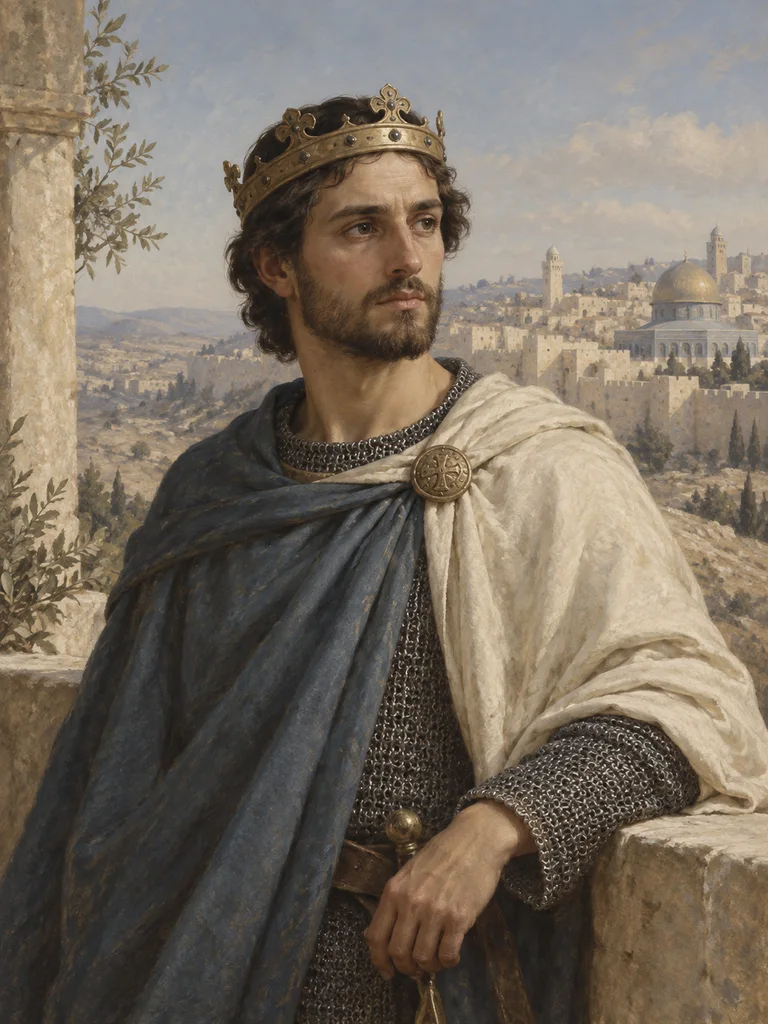
Created for Dylanvir LLC using Codex image generation from our original prompts.
AI-generated interpretation: face, clothing, and setting are imagined.
Follow one chapter at a time, or open the whole account.
01How it began
Established in 1099 when the First Crusade stormed Jerusalem, a Latin Christian kingdom planted on the Levantine coast by European crusaders thousands of miles from home.
02At its height
12th century, roughly 1130s-1180s: at its height under kings like Baldwin III and Amalric the kingdom controlled the coast from Beirut to Gaza and inland to the Jordan, dominated by great castles and the military orders, and briefly extended influence toward Egypt.
Territory in the record
A thin strip along the eastern Mediterranean coast (the Levant), with the holy city of Jerusalem inland, ringed by the allied crusader states of Tripoli, Antioch, and Edessa.
03What became of it
Crippled at the Battle of Hattin in 1187, where Saladin destroyed the kingdom's field army; Jerusalem itself surrendered to Saladin months later. The rump kingdom clung to the coast, capital at Acre, through further crusades until the fall of Acre to the Mamluks in 1291 extinguished it.
04What remained
The defining example of the over-extended garrison-state, a Western European kingdom transplanted onto hostile ground, permanently outnumbered and dependent on the sea. It shaped castle architecture, the military orders (Templars and Hospitallers), Italian naval-commercial power in the eastern Mediterranean, and the whole memory of the Crusades in both Europe and the Islamic world.
Made for Dylanvir LLC · about these images
The painted portraits and landscapes were created here with Codex image generation from our original prompts, written for this collection. They are original generated illustrations, not photographs or reproductions of archival portraits.
Each house portrait accompanies a person already named in its account. Faces, clothing, and settings are imagined; a realistic painting does not establish a historical likeness. Entries without a named figure keep their text without an invented representative.
The flags and heraldic drawings are original illustrations for Dylanvir LLC, drawn with Codex after their linked historical references. The designs themselves belong to their historical or living traditions. Captions distinguish flags, coats of arms, parts of arms, and badges, and identify the period and use shown.
This reading keeps the wording of the atlas's public house entry. The people named here are those in this entry, not a complete family tree. About the sources ↗