
Volume III · The Houses
Knights Templar (The Poor Fellow-Soldiers of Christ and of the Temple of Solomon)
Kingdom of Jerusalem / Latin Christendom
This entry has no dated engagement span in the atlas yet.
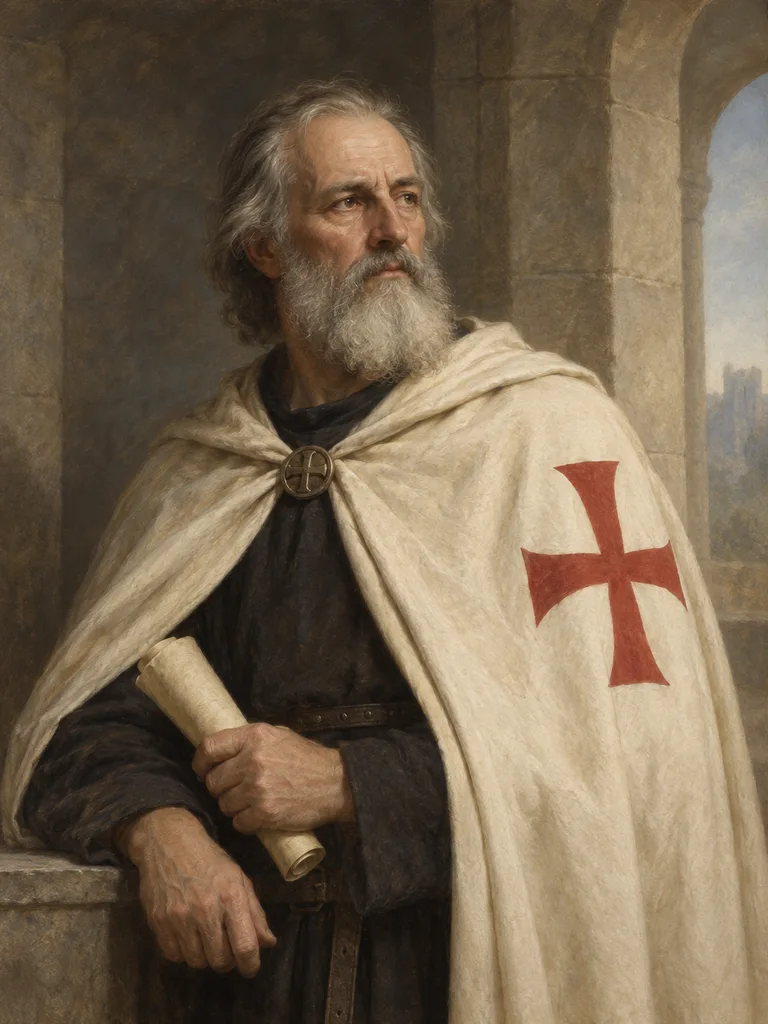
Created for Dylanvir LLC using Codex image generation from our original prompts.
AI-generated interpretation: face, clothing, and setting are imagined.
Follow one chapter at a time, or open the whole account.
01How it began
Kingdom of Jerusalem / Latin Christendom
02At its height
By the 13th century, roughly 15,000-20,000 members and a network of preceptories, farms, castles, and banking houses across Latin Christendom; a standing corps of heavily armored warrior-monks and the wealthiest, most trusted financial institution in Europe.
Territory in the record
Founded on the Temple Mount in Jerusalem (from which the Order took its name), then headquartered at Acre, then Cyprus after the Crusader states fell. Estates and banking houses stretched from the Holy Land across France, England, Iberia, and Italy.
03What became of it
Suppressed by King Philip IV of France, who was deep in debt to the Order. On Friday 13 October 1307 he had the Templars of France arrested en masse on charges of heresy, blasphemy, and sodomy; confessions were extracted under torture. Pressured by Philip, Pope Clement V dissolved the Order in 1312. The last Grand Master, Jacques de Molay, was burned at the stake in Paris in 1314 after publicly recanting his forced confession.
04What remained
Warrior-monks who also pioneered international banking: a traveler could deposit funds at one preceptory and draw on them at another, an early letter-of-credit system that made the Order Europe's first multinational bank. Their brutal, public destruction fed centuries of legend and conspiracy. The Chinon Parchment, rediscovered in the Vatican Secret Archives in 2001, records that Clement V had secretly absolved the Templar leaders of heresy in 1308 - evidence that the suppression was driven far more by royal debt and politics than by genuine belief in their guilt.
Made for Dylanvir LLC · about these images
The painted portraits and landscapes were created here with Codex image generation from our original prompts, written for this collection. They are original generated illustrations, not photographs or reproductions of archival portraits.
Each house portrait accompanies a person already named in its account. Faces, clothing, and settings are imagined; a realistic painting does not establish a historical likeness. Entries without a named figure keep their text without an invented representative.
The flags and heraldic drawings are original illustrations for Dylanvir LLC, drawn with Codex after their linked historical references. The designs themselves belong to their historical or living traditions. Captions distinguish flags, coats of arms, parts of arms, and badges, and identify the period and use shown.
This reading keeps the wording of the atlas's public house entry. The people named here are those in this entry, not a complete family tree. About the sources ↗