
Volume III · The Houses
Haudenosaunee Confederacy (Iroquois / Six Nations)
Union of Five Nations - Mohawk, Oneida, Onondaga, Cayuga, and Seneca - in the Northeastern Woodlands, founded before European contact under the Great Law of Peace; the Tuscarora joined c. 1722 to make Six Nations
This entry has no dated engagement span in the atlas yet.
Follow one chapter at a time, or open the whole account.
01How it began
Union of Five Nations - Mohawk, Oneida, Onondaga, Cayuga, and Seneca - in the Northeastern Woodlands, founded before European contact under the Great Law of Peace; the Tuscarora joined c. 1722 to make Six Nations
02At its height
17th-18th centuries; the dominant power broker of the Northeast, controlling much of the fur trade and holding the balance between the French and the British
Territory in the record
Present-day upstate New York and the Great Lakes-St. Lawrence region, with influence extending across the Northeastern and Ohio-country Woodlands
03What became of it
Split during the American Revolution when member nations took opposing sides; most land was lost after 1779-1794, but the Confederacy endures as a governing body across reservations in New York, Ontario, and Quebec
04What remained
One of the world's oldest participatory democracies; the Great Law of Peace is cited as an influence on American federal and democratic thought, and the Confederacy remains politically active
Flags, arms & symbols
A closer look at the designs associated with this entry. Open an illustration to read its story.
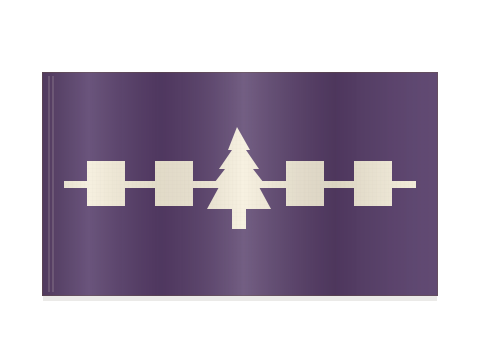 FlagThe Hiawatha Belt flagContemporary flag drawn from an older living traditionRead the symbolClose the story
Four squares and a central Tree of Peace are connected across a purple field. The tree represents Onondaga; the connected figures recall the five founding nations.
The Onondaga Nation explains that the older Hiawatha Belt has become a flag flown today. This is a contemporary symbol of a living confederacy, not a reconstructed flag from its founding or a European coat of arms.
Original illustrations for Dylanvir LLC, drawn with Codex after the linked historical references. These are schematic drawings, with simplified shapes and colours, not photographs of surviving objects. Each caption identifies the use shown.
Made for Dylanvir LLC · about these images
The painted portraits and landscapes were created here with Codex image generation from our original prompts, written for this collection. They are original generated illustrations, not photographs or reproductions of archival portraits.
Each house portrait accompanies a person already named in its account. Faces, clothing, and settings are imagined; a realistic painting does not establish a historical likeness. Entries without a named figure keep their text without an invented representative.
The flags and heraldic drawings are original illustrations for Dylanvir LLC, drawn with Codex after their linked historical references. The designs themselves belong to their historical or living traditions. Captions distinguish flags, coats of arms, parts of arms, and badges, and identify the period and use shown.
This reading keeps the wording of the atlas's public house entry. The people named here are those in this entry, not a complete family tree. About the sources ↗