
Volume III · The Houses
Greco-Bactrian and Indo-Greek Kingdom
Born around 250 BC when the Greek satrap Diodotus broke Bactria (northern Afghanistan and southern Central Asia) away from the Seleucid Empire, one of the successor states seeded by Alexander's conquests and his Greek and Macedonian colonists.
This entry has no dated engagement span in the atlas yet.
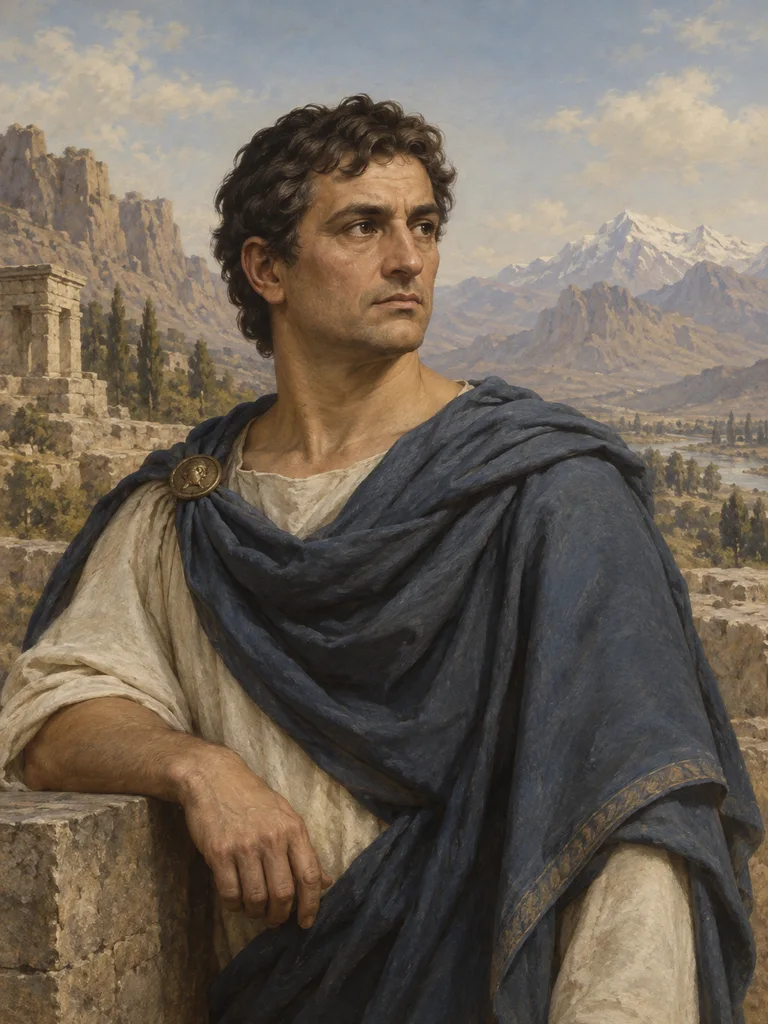
Created for Dylanvir LLC using Codex image generation from our original prompts.
AI-generated interpretation: face, clothing, and setting are imagined.
Follow one chapter at a time, or open the whole account.
01How it began
Born around 250 BC when the Greek satrap Diodotus broke Bactria (northern Afghanistan and southern Central Asia) away from the Seleucid Empire, one of the successor states seeded by Alexander's conquests and his Greek and Macedonian colonists.
02At its height
2nd century BC: a prosperous Hellenistic kingdom of a thousand cities that pushed south over the Hindu Kush into the Indus valley and northwestern India, where under kings like Menander I the Indo-Greek offshoot ruled a wealthy Greek-Indian world.
Territory in the record
Bactria and Sogdia (modern Afghanistan, Uzbekistan, Tajikistan) and, in its Indo-Greek phase, the Kabul valley, Gandhara, and the northwestern Indian subcontinent.
03What became of it
The Bactrian homeland was overrun in the 2nd century BC by nomadic invasions from the steppe (the Yuezhi/Scythians), who later coalesced into the Kushan Empire. The Indo-Greek kingdoms south of the mountains lingered until roughly the start of the 1st century AD before being absorbed.
04What remained
The far-eastern edge of the Hellenistic world, a Greek civilization surviving for two centuries on the frontier of the steppe and India. Its lasting mark is cultural fusion: Greco-Buddhist art, above all the Gandhara school that first depicted the Buddha in human form using Greek sculptural style, and the transmission of Greek artistic and possibly philosophical ideas eastward. The Milinda Panha records a dialogue between the Greek king Menander and a Buddhist sage.
Made for Dylanvir LLC · about these images
The painted portraits and landscapes were created here with Codex image generation from our original prompts, written for this collection. They are original generated illustrations, not photographs or reproductions of archival portraits.
Each house portrait accompanies a person already named in its account. Faces, clothing, and settings are imagined; a realistic painting does not establish a historical likeness. Entries without a named figure keep their text without an invented representative.
The flags and heraldic drawings are original illustrations for Dylanvir LLC, drawn with Codex after their linked historical references. The designs themselves belong to their historical or living traditions. Captions distinguish flags, coats of arms, parts of arms, and badges, and identify the period and use shown.
This reading keeps the wording of the atlas's public house entry. The people named here are those in this entry, not a complete family tree. About the sources ↗