
Volume III · The Houses
Valois Duchy of Burgundy
Created in 1363 when King John II of France granted the duchy of Burgundy to his youngest son, Philip the Bold, founding a cadet branch of the House of Valois that would soon outshine the crown it sprang from.
This entry has no dated engagement span in the atlas yet.
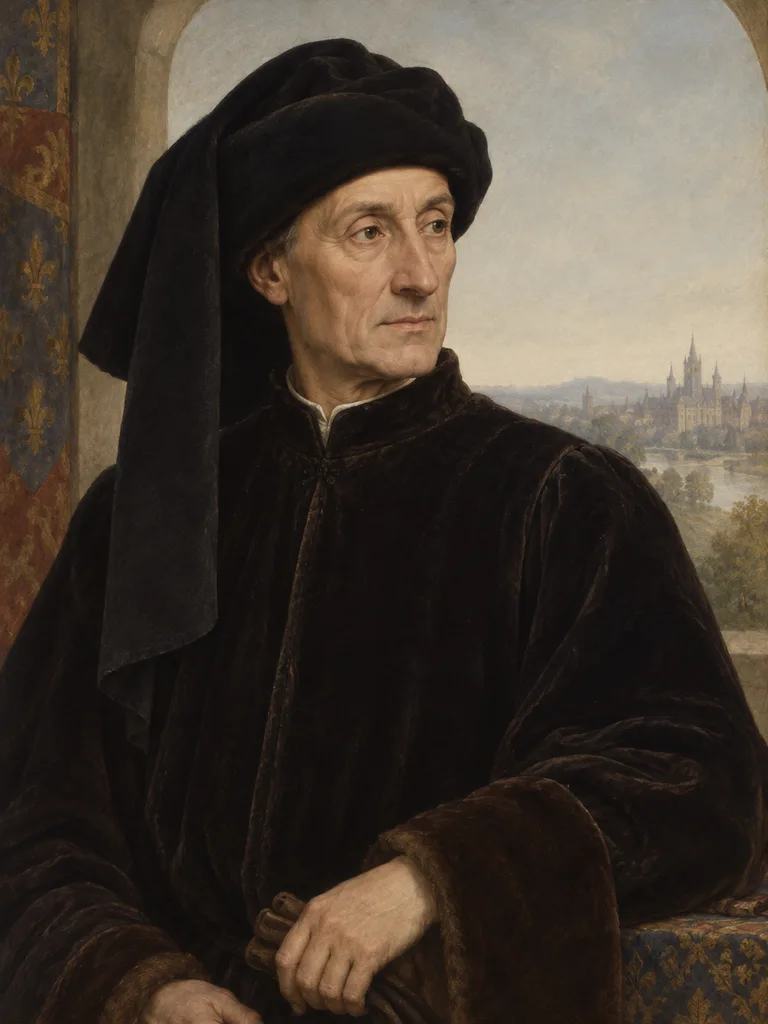
Created for Dylanvir LLC using Codex image generation from our original prompts.
AI-generated interpretation: face, clothing, and setting are imagined.
Follow one chapter at a time, or open the whole account.
01How it began
Created in 1363 when King John II of France granted the duchy of Burgundy to his youngest son, Philip the Bold, founding a cadet branch of the House of Valois that would soon outshine the crown it sprang from.
02At its height
Mid-15th century under Philip the Good and Charles the Bold: the richest court in Europe, master of the wool and cloth wealth of Flanders and the Low Countries, patron of Van Eyck and the Order of the Golden Fleece, and a power that dealt with France and England as an equal.
Territory in the record
A discontinuous realm straddling the France-Empire border: the two Burgundies in the east and, to the north, the immensely wealthy Low Countries (Flanders, Brabant, Holland, Hainaut, Luxembourg), never quite joined into one contiguous state.
03What became of it
Charles the Bold gambled on forging a kingdom to bridge his northern and southern lands and was killed at the Battle of Nancy in 1477. His inheritance was partitioned: France seized the duchy of Burgundy itself, while the rich Low Countries passed through his daughter Mary's marriage to Maximilian of Habsburg, carrying that wealth into the Habsburg empire.
04What remained
The classic 'middle kingdom' that almost was: a would-be Lotharingian state between France and Germany that dissolved at the moment it reached for a crown. Its collapse fed the two powers that framed early modern Europe, handing the Low Countries to the Habsburgs and setting up the long Valois-Habsburg and Franco-Burgundian struggles.
Flags, arms & symbols
A closer look at the designs associated with this entry. Open an illustration to read its story.
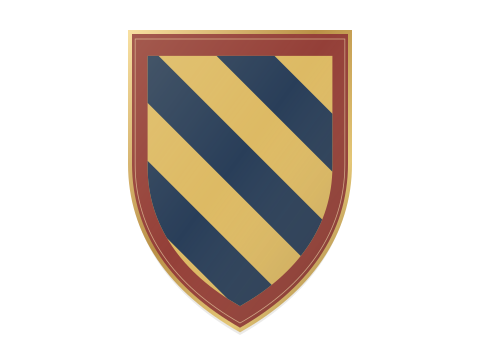 Arms componentBurgundy AncientA field within the composite ducal armsRead the symbolClose the story
Alternating gold and blue diagonal bands, enclosed by a red border. Heraldry calls this field Burgundy Ancient.
The dukes combined inherited territories within larger shields. This plate shows one component, not the whole coat of arms of Philip the Good. The linked catalogues show the wider combinations and their later inheritance.
Original illustrations for Dylanvir LLC, drawn with Codex after the linked historical references. These are schematic drawings, with simplified shapes and colours, not photographs of surviving objects. Each caption identifies the use shown.
Made for Dylanvir LLC · about these images
The painted portraits and landscapes were created here with Codex image generation from our original prompts, written for this collection. They are original generated illustrations, not photographs or reproductions of archival portraits.
Each house portrait accompanies a person already named in its account. Faces, clothing, and settings are imagined; a realistic painting does not establish a historical likeness. Entries without a named figure keep their text without an invented representative.
The flags and heraldic drawings are original illustrations for Dylanvir LLC, drawn with Codex after their linked historical references. The designs themselves belong to their historical or living traditions. Captions distinguish flags, coats of arms, parts of arms, and badges, and identify the period and use shown.
This reading keeps the wording of the atlas's public house entry. The people named here are those in this entry, not a complete family tree. About the sources ↗