
Volume III · The Houses
The Kingdoms of Anatolia (Asia Minor)
Not one dynasty but a peninsula. Anatolia (modern Turkey) is history's great crossroads, the land bridge between Europe and Asia, and it has been a kingdom-factory for more than three millennia. This entry walks the succession of powers that held the bridge rather than a single bloodline.
This entry has no dated engagement span in the atlas yet.
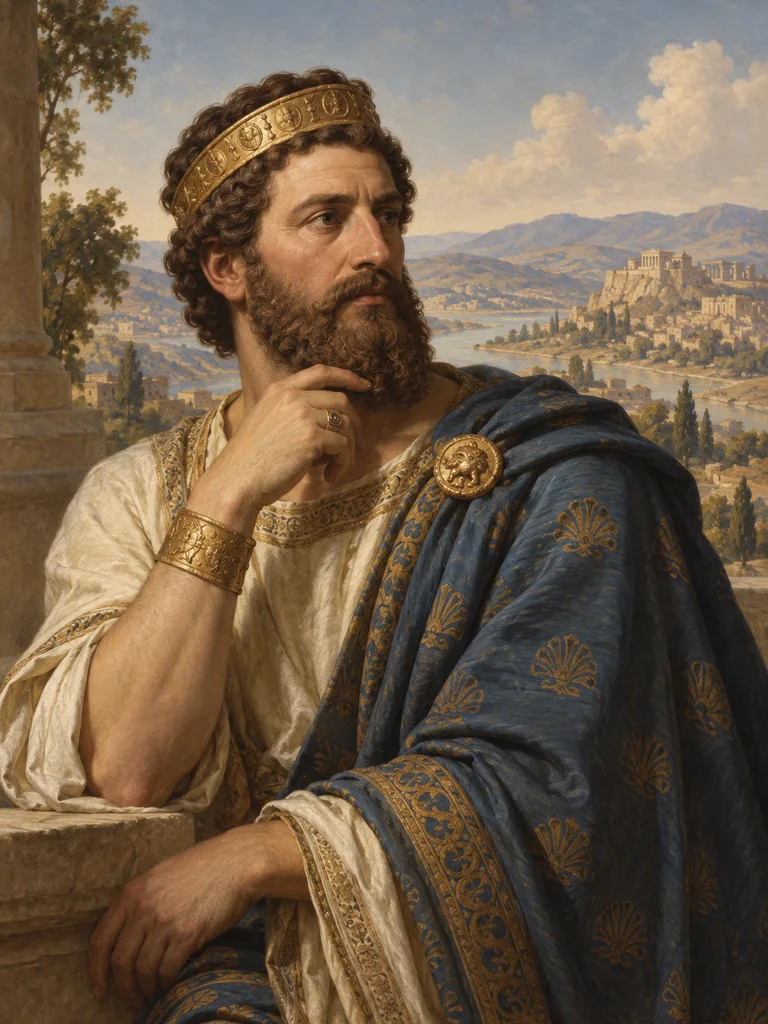
Created for Dylanvir LLC using Codex image generation from our original prompts.
AI-generated interpretation: face, clothing, and setting are imagined.
Follow one chapter at a time, or open the whole account.
01How it began
Not one dynasty but a peninsula. Anatolia (modern Turkey) is history's great crossroads, the land bridge between Europe and Asia, and it has been a kingdom-factory for more than three millennia. This entry walks the succession of powers that held the bridge rather than a single bloodline.
02At its height
Every age had its Anatolian power. The Hittites rivaled Egypt and Babylon in the Bronze Age; Lydia under Croesus was a byword for wealth; Byzantine Anatolia was the recruiting and tax heartland of the medieval Roman Empire; and the peninsula finally became the launch-base of the Ottoman world empire.
Territory in the record
The Anatolian peninsula and its coasts and highlands, the contested hinge between the Aegean/Balkans to the west and Mesopotamia, the Caucasus, and Iran to the east.
03What became of it
Each holder was in turn displaced by the next wave from a different direction, until the Turks arrived after Manzikert (1071) and never left. The Seljuk Sultanate of Rum Turkified the interior; out of its wreckage the Ottomans rose to hold the bridge for six centuries, succeeded by the Republic of Turkey.
04What remained
The lesson of the crossroads itself: whoever holds Anatolia holds the passage between two continents, the chokepoint of the Straits, and one of the richest recruiting grounds in the world. It made the fortune of every power that took it and doomed every empire (Byzantium above all) that lost it.
Made for Dylanvir LLC · about these images
The painted portraits and landscapes were created here with Codex image generation from our original prompts, written for this collection. They are original generated illustrations, not photographs or reproductions of archival portraits.
Each house portrait accompanies a person already named in its account. Faces, clothing, and settings are imagined; a realistic painting does not establish a historical likeness. Entries without a named figure keep their text without an invented representative.
The flags and heraldic drawings are original illustrations for Dylanvir LLC, drawn with Codex after their linked historical references. The designs themselves belong to their historical or living traditions. Captions distinguish flags, coats of arms, parts of arms, and badges, and identify the period and use shown.
This reading keeps the wording of the atlas's public house entry. The people named here are those in this entry, not a complete family tree. About the sources ↗