Dylanvir
Atlas

Volume II · The Modern Age

Napoleon Bonaparte

General and emperor

2 engagements in this atlasRecorded here: 1805 — 1815

A reading of the engagements that name Napoleon Bonaparte. These records trace part of a life, not a complete biography.

Begin the account ↓
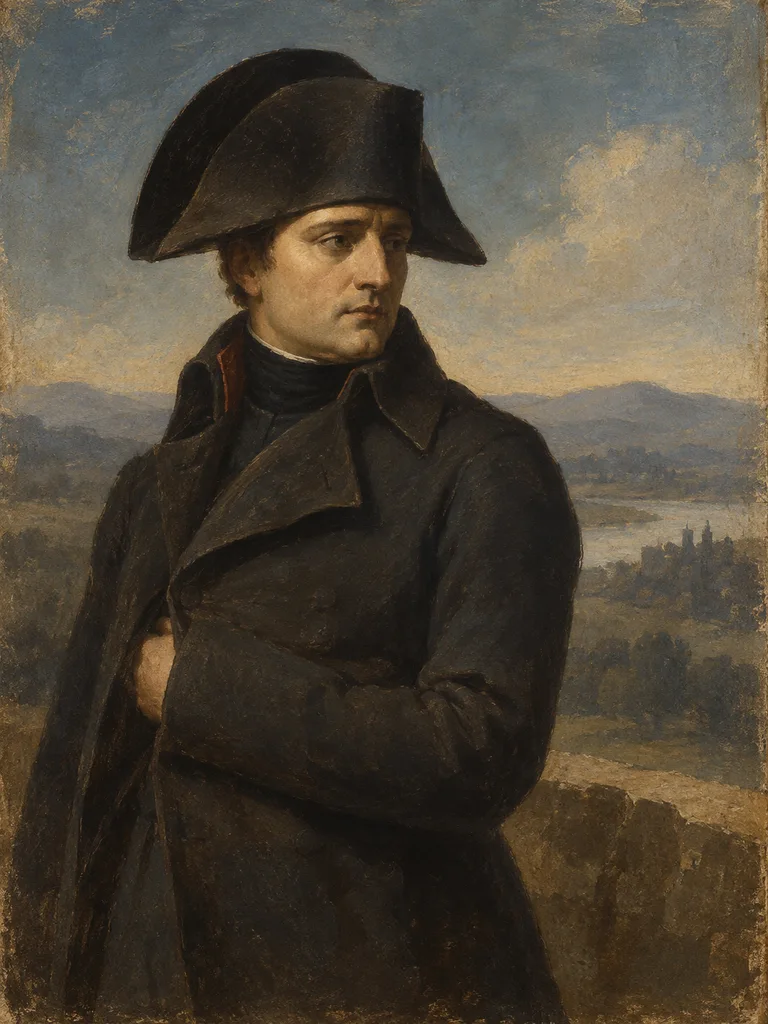
Imagined painted interpretation of Napoleon Bonaparte.
Created for Dylanvir LLC using Codex image generation from our original prompts. AI-generated interpretation. Face and costume are imagined.

Follow one chapter at a time, or open the whole account.

1805

Battle of Austerlitz

The setting
near Austerlitz, Moravia (modern Czech Republic)

Rolling country dominated by the Pratzen Heights

Reveal the outcome

Recorded sideFrench Empire

Recorded resultvictory

Decisive French victory; collapse of the Third Coalition

How the atlas explains it

Napoleon deliberately gave up the Pratzen Heights and weakened his right to bait the allies into attacking it. When they committed their center to the flanking move, he stormed the now-empty heights, split their army in two, and rolled up the isolated wings.

What followed

Regarded as Napoleon's tactical masterpiece and a model of luring an enemy into overcommitting.

Full engagement entry, figures and caveats ↗

1815

Battle of Waterloo

The setting
Near Waterloo, south of Brussels, in present-day Belgium (then United Kingdom of the Netherlands)

An east-west ridge (Mont-Saint-Jean) bisected by the Brussels road, with a sunken Ohain road along the crest and fortified strongpoints at Hougoumont, La Haye Sainte, and Papelotte to the front.

Reveal the outcome

Recorded sideFrench (Armee du Nord, Napoleon)

Recorded resultarmy destroyed

Decisive Coalition victory; the French army was routed

How the atlas explains it

Wellington's defensive use of the reverse slope and the fortified farms blunted repeated French assaults through the day, fixing Napoleon's army in place until Blucher's Prussians arrived on the French right flank, giving the Coalition decisive numerical superiority; the repulse of the Imperial Guard's final attack collapsed French morale.

What followed

Ended Napoleon's Hundred Days and his rule, brought the final collapse of the First French Empire, and opened a long period of relative peace in Europe.

Full engagement entry, figures and caveats ↗

The text gathers this atlas's public engagement records. Explanations and uncertainties belong to those records; an outcome here does not grade a life. About the sources ↗