
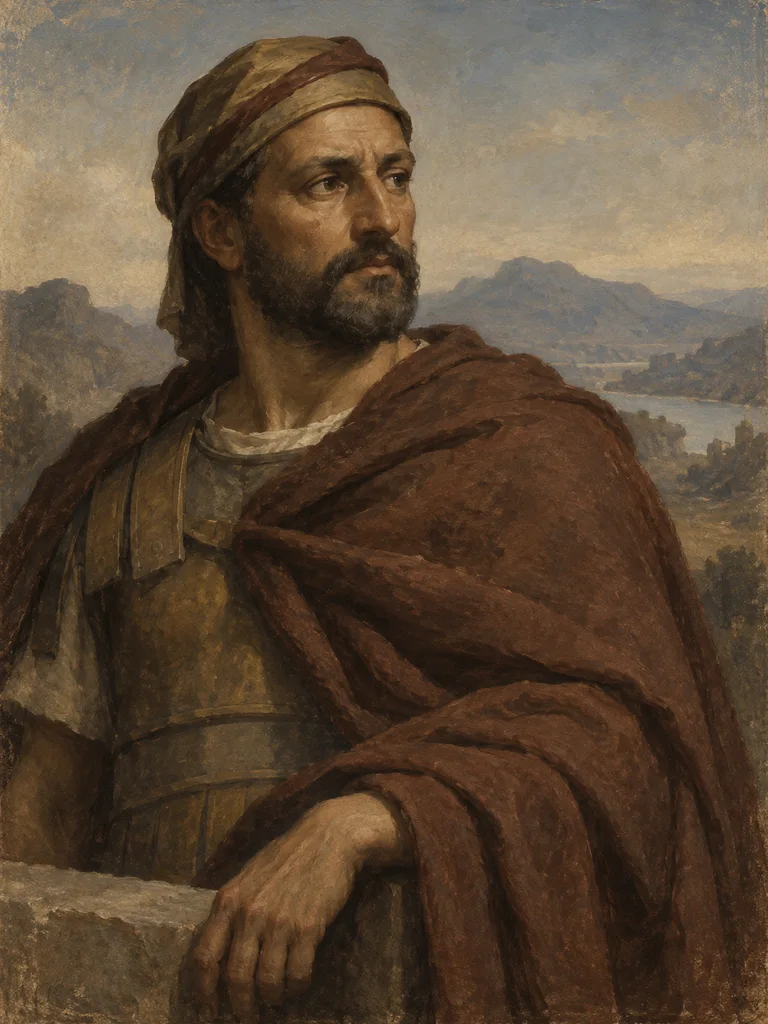
Follow one chapter at a time, or open the whole account.
1The situation
On the plain beside the river
Open plain beside the Aufidus (Ofanto) river
Carthage
Roman Republic
No commander is named for this side in this atlas entry.
These are the sides and names held in the existing record. Open the next chapter to follow the encirclement.
2The decision
A line that gives way
Choose a stage to see how the account describes the movement.
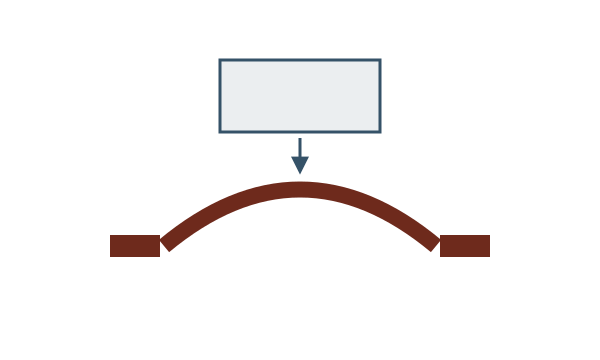
A centre pushed forward
Hannibal places his central infantry ahead of the wings. The curved line faces the Roman advance.
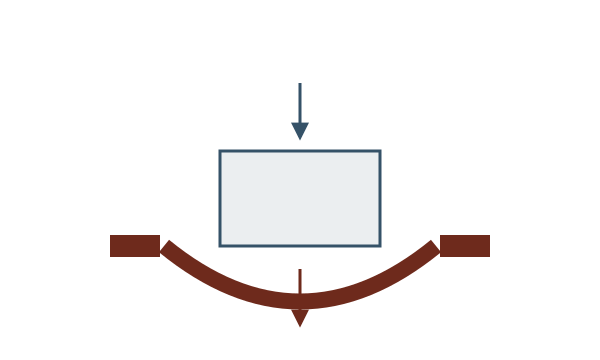
The advance draws inward
As the centre falls back, the Romans press into it. The African infantry now stands on either side of the advancing Roman formation.
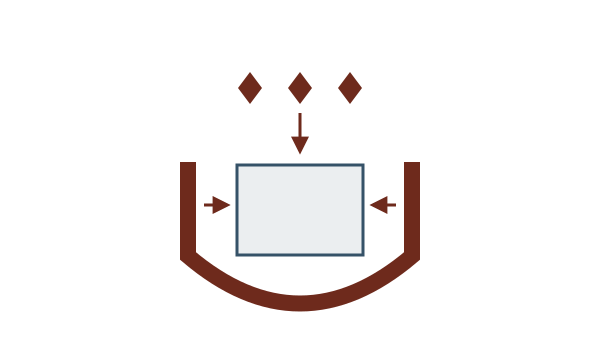
Pressure from both sides and behind
The African infantry turns against the Roman flanks. Carthaginian cavalry attacks the rear, completing the encirclement.
A schematic of the encirclement, not a battlefield map. Shapes do not show troop numbers, distances, orientation or timing. Earlier cavalry and skirmisher fighting is omitted.
Original diagrams for Dylanvir LLC, drawn with Codex after the atlas account and Polybius, Histories III.113–116.
Read the atlas explanation in full
Hannibal pushed his weakest troops forward in a crescent. As the massed Romans drove the center back, it bent inward by design; his veteran African infantry on the wings and his cavalry closed behind, sealing the Romans into a shrinking pocket where numbers became a death trap.
3The outcome
Decisive Carthaginian victory; one of the bloodiest single days in military history
- Carthage
- victory
- Roman Republic
- defeat
Open the recorded losses and their limits
Approximate figures as recorded in this atlas; they are not precise totals. The Roman range combines killed or captured.
- Carthage
- ~6,000
- Rome
- ~50,000–70,000 killed or captured
The diagram shows the movement; these figures describe its human cost. The complete account and source context remain below.
4The aftermath
Beyond this victory
The archetypal battle of annihilation by encirclement; the benchmark every later commander measured against.
A battle is one moment in the longer record. Follow Hannibal to another named engagement below to see how its outcome differs.
This entry gives the battle's significance; it does not contain a full account of the immediate aftermath.
The original atlas account · figures, tactics and context
This is the earlier entry, preserved alongside the illustrated reading.
2 Aug 216 BC · Second Punic War · Cannae, Apulia (Italy) · Open plain beside the Aufidus (Ofanto) river
Hannibal Barca · ~50,000
commanders unrecorded · ~86,000
Decisive Carthaginian victory; one of the bloodiest single days in military history
why it worked — Hannibal pushed his weakest troops forward in a crescent. As the massed Romans drove the center back, it bent inward by design; his veteran African infantry on the wings and his cavalry closed behind, sealing the Romans into a shrinking pocket where numbers became a death trap.
The archetypal battle of annihilation by encirclement; the benchmark every later commander measured against.
casualties · Carthage: ~6,000 · Rome: ~50,000–70,000 killed or captured
tactics: Double Envelopment (Pincer) · Combined Arms
Read the account behind the drawing
The story retains this atlas's existing account. The movement diagrams also follow Polybius, Histories III.113–116, which describes the centre, flanking infantry and cavalry at the rear.
Polybius offers an ancient narrative, not an eyewitness battlefield plan. The drawings simplify that account; they do not independently establish troop positions or intentions.
Explore the atlas sources and their limits ↗